← Back to the blog
ADHD and emotion
•
If 99% of people with ADHD have it, is it still dysphoria? What a poll of my readers suggests about rejection sensitivity.
This article first appeared on 23 July 2026 in #NDChat, my newsletter on LinkedIn.
🟠 If 99% of people with ADHD have it, is it still dysphoria?
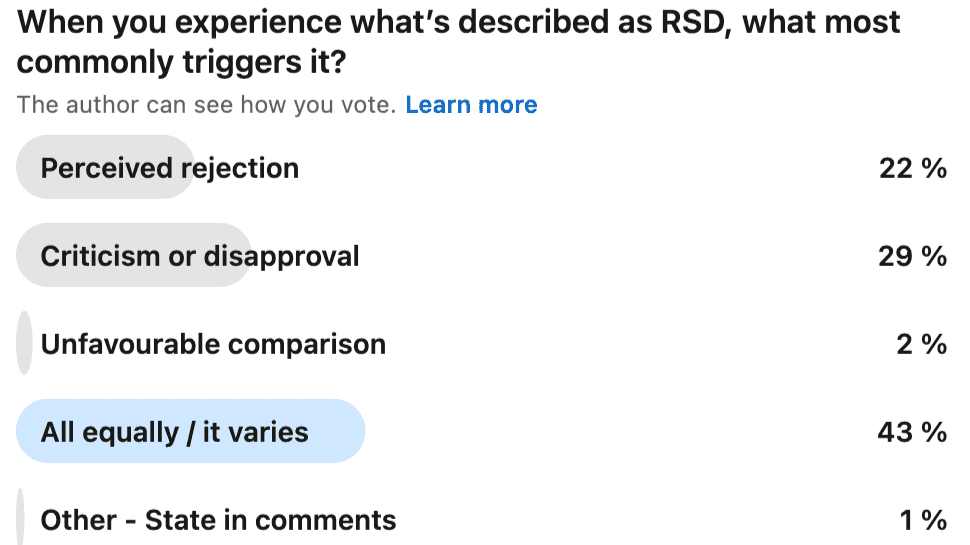
🟠 Only 22% chose perceived rejection as the most common trigger…

Before I say anything else, this was a LinkedIn poll and not a clinical study or peer-reviewed data. I’m not going to claim otherwise.
What it is, however, is a real-world signal. And such signals are worth paying attention to.
The results
When asked what most commonly triggers what they describe as RSD:
🟠 Perceived rejection — 22%
🟠 Criticism or disapproval — 29%
🟠 Unfavourable comparison — 2%
🟠 All equally / it varies — 43%
🟠 Other — 1%
Only 1 in 5 people identified rejection as their primary trigger.
The largest group couldn’t identify a consistent trigger at all.
What I am and am not saying
I am not trying to dismantle RSD. The experience people describe is real, and I know this because I live it.
Something happens. A tone shifts, a message takes too long, a comment lands wrong.
Before any conscious thought has formed, my stomach drops. There’s a lump in my throat. Something that feels genuinely painful and overwhelming, arriving whole and without warning, with a force that bears absolutely no relationship to what just happened.
And then, when I pause and sit with it and think it through, I can see how disproportionate it was.
It passes. It can be understood and worked with.
The experience is real. What I’m questioning is whether the label describes it accurately enough to actually help.
The word that doesn’t add up
Dysphoria means profound emotional suffering. It is the same word used in the context of severe depressive episodes. It is not a mild or everyday term.
🟠 Dodson claims RSD affects up to 99% of people with ADHD.
Think about what that requires you to accept: that virtually every single person with ADHD experiences profound emotional suffering in response to rejection, as a neurologically distinct phenomenon separate from the emotional dysregulation ADHD is already known to cause.
🟠 If something affects 99% of people with a condition, one of two things is true.
Either it tells you something genuinely universal about that condition, which is what emotional dysregulation does and which is well evidenced.
Or the definition has been drawn so broadly that it captures normal human experience and calls it pathology.
Dysphoria implies a severity the 99% claim cannot support. You cannot have a near-universal experience that also constitutes profound suffering as a distinct clinical phenomenon.
The word is doing significant work in that label. But when the same construct is claimed to affect virtually everyone with ADHD, the severity the word implies quietly disappears.
You can’t have it both ways.
Something I think needs saying
I’m aware that what I write here reaches several thousand people.
The RSD narrative doing the rounds on social media, in podcasts and in bestselling books reaches hundreds of thousands. Possibly millions.
We live in a moment when influencers and content creators routinely reach more people than academics, researchers, clinicians and educators. That isn’t a criticism of people sharing their experiences. It’s an observation about the world we’re in.
When a construct spreads at the speed RSD has spread, driven primarily by emotional resonance rather than evidence, the people with the loudest voices shape what millions of people believe about themselves.
That carries responsibility. And that includes me.
The answer isn’t to dismiss lived experience. It’s to insist that the frameworks we build around it are accurate enough to be genuinely useful.
A label that feels validating but doesn’t describe what’s actually happening can point people toward the wrong understanding of themselves and away from support that would actually help.
Emotional dysregulation occurs across the human population
In ADHD and autism, the research consistently shows a lower threshold for activation, greater intensity of response, and a significantly slower return to baseline.
This is partly explained by underconnectivity between the prefrontal cortex, which in neurotypical brains helps modulate emotional responses, and the limbic system.
That profile is one of the most robustly evidenced features of both conditions. Not a side effect. Central to how the nervous system works.
It doesn’t require rejection to trigger it. It doesn’t always have a consistent trigger at all.
It’s also worth being clear about what this doesn’t mean. Emotional maturity, self-awareness and the capacity to regulate responses develop in all of us over time, and that includes people with ADHD and autism.
A lower threshold and slower recovery don’t exempt anyone from developing those skills. They make it harder. The work may look different and take longer and require more support. But greater awareness and greater agency over your own responses are available to everyone.
Framing this as a fixed neurological ceiling rather than a starting point is where the real harm gets done.
There is also a risk in how RSD is sometimes used that I want to name carefully, and I don’t think most people do this consciously or with any bad intent.
When we frame an intense emotional response as a fixed condition beyond our control, it can quietly become a reason not to develop greater awareness of it.
Understanding that your nervous system responds more intensely than others is genuinely valuable. It becomes a problem when that understanding closes the conversation rather than opening it — when it becomes an explanation that doubles as an exemption.
Final thought
The goal of any honest framework should be greater self-knowledge and greater agency, not a settled account of why things will always be this way.
That’s not a weaker framework than RSD. It’s a more honest one.
And honest frameworks are the ones that actually help.


One email when a new article is published. Evidence, not hype, on ADHD, autism and neurodiversity in education. No spam, unsubscribe any time.
Your details are only used to send you new articles. See the Privacy Notice.
Whether you’re a parent, a teacher or a school leader, a free 20-minute call is a good place to start.
Book a free call
This site uses cookies to improve your experience. Cookie Policy.